
The Truth About SEO in 2026
Every year, someone declares SEO dead. In 2026, the chorus is louder than ever, with AI Overviews appearing in 13.14% of searches and zero-click results dominating 65% of Google queries. But here’s what the doomsayers aren’t telling you: SEO isn’t dying, it’s multiplying.
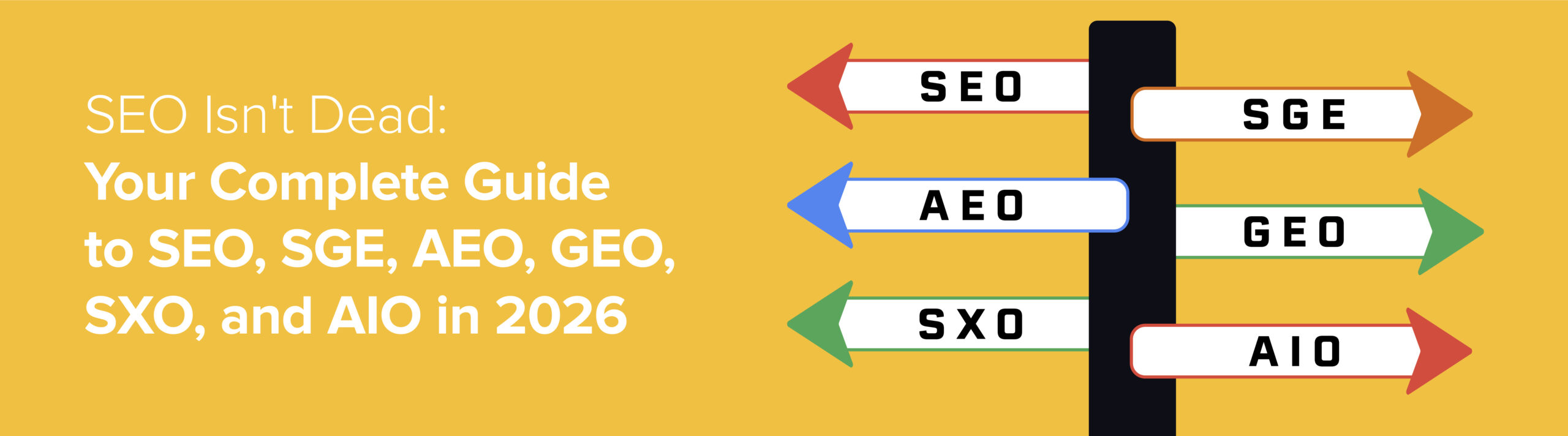
Traditional SEO remains the foundation, but now it’s joined by SGE, AEO, GEO, SXO, and AIO. These aren’t replacements for SEO; they’re expansions of it. Think of them as different doors to the same house of online visibility. Master one, and you’ll get traffic. Master them all, and you’ll dominate your market while competitors scramble to understand what hit them. The businesses winning in 2026 aren’t abandoning SEO, they’re evolving it.
Traditional SEO: The Foundation That Still Matters
Why Traditional SEO Remains Essential in an AI World
Building Your Digital Authority From the Ground Up
Despite all the AI disruption, traditional SEO still drives the majority of web traffic. Google maintains an 86% market share, and organic search results still appear below AI Overviews. More importantly, AI systems pull their information from traditionally well-ranked content. If you’re not ranking traditionally, you won’t be cited by AI.
Key Stat: “Even with AI Overviews present, 87% of users still interact with traditional organic results when the AI answer doesn’t fully satisfy their query” – Semrush 2026 Study
Your SEO Health Check:
- Core Web Vitals score above 90 for all pages
- Mobile-first design with responsive layouts
- Schema markup on all key pages
- Internal linking strategy with clear hierarchy
- E-E-A-T signals throughout content
- Regular content updates (monthly minimum)
- Technical SEO audit completed quarterly
SEO Restructuring Blueprint:
- Audit your top 20 pages for Core Web Vitals issues
- Implement semantic HTML5 structure
- Create topic clusters around main keywords
- Build authoritative backlinks from your industry
- Optimize meta descriptions for 2-3% CTR improvement
- Add FAQ schema to all informational content
Traditional SEO isn’t just surviving, it’s the bedrock everything else builds upon.
SGE: Search Generative Experience
Optimizing for Google’s AI-Powered Future
Making Your Content SGE-Ready Today
Search Generative Experience represents Google’s vision for AI-integrated search. With SGE expanding globally and appearing in more query types, optimizing for it means structuring content to be easily synthesized by AI while maintaining traditional ranking signals.
SGE prioritizes content that directly answers user intent with clear, factual information. It’s not about gaming an algorithm, it’s about becoming the most trustworthy source in your niche.
Industry Insight: “Healthcare and finance sectors see SGE appearances in 24% of queries, while e-commerce hovers at 15%, vertical-specific optimization is crucial” – BrightEdge 2026
SGE Compatibility Checklist:
- Clear, conversational headings that mirror search queries
- Bullet points and numbered lists for scannable content
- Definitive answers in the first 100 words
- Supporting evidence with citations
- Related entity mentions throughout content
- Fresh statistics and data (less than 6 months old)
- Mobile-optimized tables and infographics
SGE Optimization Framework:
- Rewrite introductions to answer queries immediately
- Add “Quick Answer” boxes at the top of articles
- Include pros/cons lists for comparison content
- Create definition boxes for technical terms
- Add timestamp metadata for time-sensitive content
- Structure content with clear H2/H3 hierarchy
SGE rewards clarity and authority. Deliver both, and you’ll appear in AI-generated responses.
AEO: Answer Engine Optimization
Becoming the Direct Answer Users Seek
Winning Featured Snippets and Voice Search
Answer Engine Optimization focuses on becoming the direct answer for voice assistants, featured snippets, and knowledge panels. With 36.6% of Americans using voice assistants daily, AEO isn’t optional, it’s essential for capturing conversational searches.
The secret to AEO success? Write like you’re answering a friend’s question: clear, concise, and immediately helpful. Search engines want to provide instant value, and AEO ensures you’re the source they choose.
Critical Metric: “Content optimized for AEO sees a 42% increase in featured snippet capture and 3x more voice search selections” – Conductor Intelligence 2026
AEO Readiness Assessment:
- Target question-based keywords (“how to,” “what is,” “why does”)
- Answer format matches query intent (list, paragraph, table)
- Answers are 40-60 words for optimal snippet length
- Use trigger words that match voice search patterns
- Include structured data markup (FAQ, HowTo)
- Natural language that mirrors conversational queries
- Mobile-first formatting for voice device screens
AEO Implementation Strategy:
- Research “People Also Ask” boxes for your keywords
- Create dedicated FAQ pages with schema markup
- Write definition paragraphs for all key terms
- Format step-by-step guides with numbered lists
- Add comparison tables for versus searches
- Optimize for long-tail conversational keywords
Master AEO, and you’ll own the answer boxes that get 35% of all clicks.
GEO: Generative Engine Optimization
Optimizing for AI That Creates Content
Becoming the Source AI Trusts and Citations
Generative Engine Optimization prepares your content to be referenced by AI tools like ChatGPT, Claude, Perplexity, and Google’s Gemini. With AI-generated responses increasingly replacing traditional search, GEO ensures you’re the authority these systems cite.
GEO isn’t about keywords, it’s about becoming the most credible, comprehensive source that AI models naturally reference. When AI writes about your industry, your content should be its primary source.
Market Reality: “82% of AI-generated responses reference sources with strong entity relationships and organized data structures” – Authoritas 2026
GEO Compatibility Audit:
- Semantic richness with related entities mentioned
- Clear factual statements without ambiguity
- Authoritative tone with evidence-based claims
- Updated statistics and current information
- Comprehensive coverage of topic aspects
- Cross-references to other authoritative sources
- Structured data markup throughout
GEO Enhancement Roadmap:
- Create comprehensive pillar pages (3,000+ words)
- Add evidence tables with sources
- Include expert quotes and citations
- Build topic authority through content depth
- Implement JSON-LD structured data
- Maintain content freshness with quarterly updates
When AI needs an answer, GEO makes sure it comes from you.
SXO: Search Experience Optimization
Creating Experiences That Convert
Beyond Rankings to Real User Satisfaction
Search Experience Optimization combines SEO with user experience to create content that doesn’t just rank, it satisfies and converts. With Google’s emphasis on user signals, SXO has become the differentiator between sites that rank and sites that dominate.
SXO recognizes a fundamental truth: search engines want to send users to sites that solve their problems completely. It’s not enough to rank; you must deliver an experience that keeps users engaged and satisfied.
Performance Data: “Sites optimizing for SXO see 31% lower bounce rates and 2.4x higher conversion rates than traditional SEO-only approaches” – Fruitbowl Digital 2026
SXO Quality Indicators:
- Page load time under 2.5 seconds
- Interactive elements respond within 100ms
- Clear visual hierarchy with scannable content
- Intuitive navigation with breadcrumbs
- Engaging multimedia (videos, infographics, tools)
- Progressive disclosure for complex information
- Accessibility features for all users
SXO Transformation Checklist:
- Implement lazy loading for images and videos
- Add interactive calculators or tools
- Create custom graphics instead of stock photos
- Design mobile-first with thumb-friendly navigation
- A/B test CTA placements and colors
- Reduce cognitive load with white space
SXO turns visitors into customers by making their journey effortless.
AIO: AI Overview Optimization
Dominating Google’s AI-Generated Summaries
Your Blueprint for AI Overview Inclusion
AI Overview Optimization specifically targets Google’s AI Overviews, which now appear in 13.14% of searches and growing. Unlike other optimizations, AIO requires understanding exactly how Google’s AI selects and synthesizes information for these prominent SERP features.
The key to AIO success is understanding that Google’s AI prioritizes recent, authoritative content that directly addresses user intent. Your content needs to be both comprehensive enough to be trusted and concise enough to be easily extracted.
Growth Trajectory: “AI Overviews increased by 112% from April to July 2025, with informational queries seeing 47% coverage in some verticals” – Conductor AI Overview Study
AIO Inclusion Checklist:
- Target 8+ word informational queries
- Maintain content freshness (updated within 30 days)
- Include clear, definitive statements
- Use lists and bullet points liberally
- Add supporting statistics with sources
- Optimize for mobile-first indexing
- Include relevant entity mentions
AIO Optimization Tactics:
- Research queries triggering AI Overviews in your niche
- Create “Overview” sections summarizing key points
- Add numbered lists for process-based content
- Include comparison tables for product queries
- Update content when new information emerges
- Build topical authority through content clusters
Nail AIO, and you’ll appear above traditional results in Google’s most visible position.
Bringing It All Together: The Integration Strategy
The Multi-Channel Optimization Approach
The future isn’t about choosing between SEO, AEO, GEO, SXO, SGE, or AIO, it’s about integrating all of them into a cohesive strategy. Each optimization method reinforces the others, creating a compound effect that multiplies your visibility across all search platforms.
Here’s how they work together: Traditional SEO gets you indexed and ranked. SGE and AIO put you in AI-generated summaries. AEO captures featured snippets and voice searches. GEO ensures AI tools cite your content. SXO converts all that traffic into business results. Miss any piece, and you’re leaving opportunity on the table.
The most successful brands in 2026 aren’t picking favorites, they’re optimizing for everything. Your content should work equally well for a Google search, a ChatGPT query, an Alexa question, and a mobile user looking for quick answers. This isn’t about more work; it’s about working smarter with content that serves multiple purposes.
Your Complete Action Plan
Stop worrying about SEO being dead and start implementing these strategies:
Week 1-2: Foundation
- Audit your current SEO performance
- Fix technical issues (Core Web Vitals, mobile, schema)
- Identify top 20 pages for optimization
Week 3-4: Content Enhancement
- Rewrite introductions for AEO (40-60 word answers)
- Add FAQ sections with schema markup
- Create comprehensive pillar content for GEO
Week 5-6: Advanced Optimization
- Implement SGE-friendly formatting (lists, tables, definitions)
- Optimize for AI Overviews with fresh statistics
- Enhance user experience for SXO (speed, design, interaction)
Week 7-8: Monitoring and Iteration
- Track rankings, featured snippets, and AI citations
- Monitor AI Overview appearances
- A/B test user experience improvements
Ongoing: Continuous Improvement
- Update content monthly with fresh data
- Build topical authority through content clusters
- Maintain technical excellence across all metrics
Ready to Dominate Search in 2026?
SEO isn’t dead, it’s more alive and complex than ever. The brands winning today understand that visibility requires a multi-faceted approach. Traditional SEO remains your foundation, but SGE, AEO, GEO, SXO, and AIO are the walls, roof, and windows that complete your digital presence.
The question isn’t whether SEO is dead. The question is: Are you ready to evolve with it?
Start today. Pick one optimization strategy from this guide and implement it this week. Your future visibility depends on the actions you take right now.